 OpenSource Connections
Category: Community
To celebrate my one year in the “real world”, I went to Toronto to attend the FutureRuby conference. The format of the conference is consistent with all other conferences Ive been to, the unConference with an unThink style of philosophy. This was also my second Ruby specific conference, and the first one I attended, RubyDCamp, was a great experience so I was looking forward to this one. There many things that got me excited about the conference, the first one was the website:
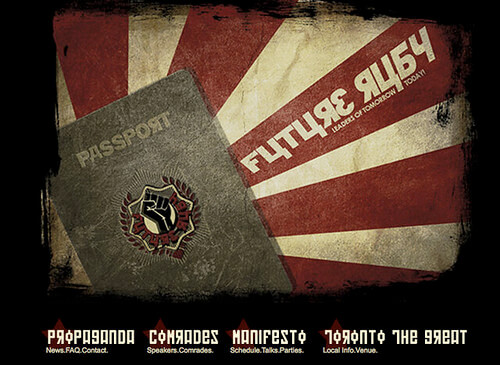
another one was the conference motto:
People who program in Ruby arent like other coders
We are the artists, philosophers, and troublemakers. We realize that the fringe of today is the mainstream of tomorrow. We grease the engines of progress, even when were working outside of the machine.
FutureRuby isnt a Ruby conference, but a conference for Rubyists. This is a call to order – a congress of the curious characters that drew us to this community in the first place. We have a singular opportunity to express a long-term vision, a future where Ruby drives creativity and prosperity without being dampened by partisan politics.
The conference location was also an added benefit. Of course it was more costly to go to Canada, but I like to travel and this was a great chance to visit a new place. The conference itself, or activities related to the conference started as early as Thursday with a iPhone app development class. Friday was the early registration day and opening party time. I got into the city Friday night, so I missed that days events. But of course everyone was talking about the party and the roof top view the next morning at breakfast, so check out this video about it:
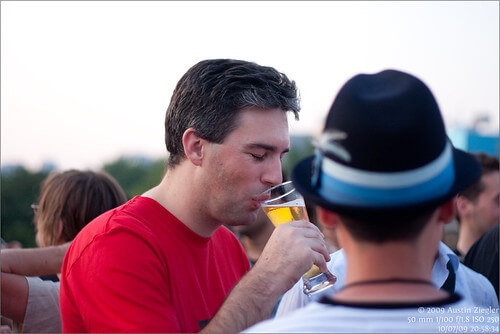


For me the conference started Saturday morning when I picked up my bag of schwag:

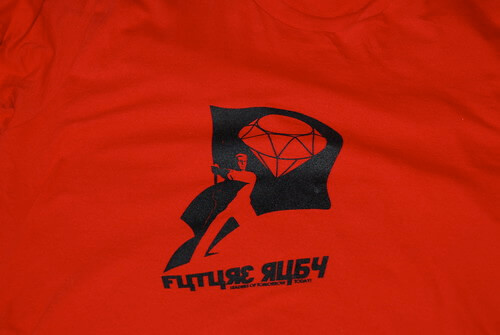

Then was the opening note by @peteforde who kicked off the weekend by expressing how he wishes that this conference is something that will help rubyists everywhere shape the future of the community. He was then followed by this great list:
Speaker: Nathaniel TalbottDescription: The revolution isnt free – none ever is. If we want to keep Ruby real and not have the life sucked out of our community by soulless corporations we have to learn to take value and turn it into cash. And yes, we can learn!Notes: Great starting presentation, funny and insightful. This presentation eased my worries that the talks will be very technical and over peoples head and I wont be able to benefit from them. The speakers biggest point is owning your work and your tools. Do not let the corporates dictate the future. Developers are the ones who use the tools and theyre the ones who should decide what to use. See the presentation here.
Speaker: Ilya GrigorikDescription: Tokyo Cabinet offers a great many features right out of the box: key-value store, ordered traversal, attribute search, schemaless data structures, and even indexing. Well explore these features with hands on examples and then delve into the advanced and little known feature of TC: ability to script it with Lua! Well explore a number of lean & mean recipes to take TC to the next level. A cache server you say? Perhaps a graph database?Notes: Of course everything conference I go to, theres a new database engine being introduced. This one was cool though and Im looking forward to see it get widely used.
Speaker: Austin CheDescription: I will discuss a programming language that makes Ruby look like childs play. The language of life, DNA, has shown its robustness and expressiveness through billions of years of pervasive use. Engineers have recently begun to use DNA to reprogram life to create a myriad of novel biological systems. Biology is currently at the tip of a revolution similar to that of electricity and magnetism at the beginning of the 20th century. The electrical engineering revolution has allowed non-physicists to program in high-level languages like Ruby by distilling classical physics into a set of engineering design principles. Similarly, the emerging field of synthetic biology applies engineering principles to biology. Efforts to bring modularity, interchangeable parts, abstraction and standardization to biology is beginning to allow non-biologists to quickly and predictably design and build biological systems. Soon, it may become childs play to program with DNA.Notes: This talk was designed to blow your mind away, in many ways. Its one of those thing you go “Hunh?!?!” about because of both how hard and technical it is and how cool it is. After the talk everyone started googling for websites where they can program DNA to spell their name. I had a talk with Austin Che at the Pravda Gala and hes a very cool guy. It was great presentation about biology and programming combined.

Speaker: Anita KunoDescription: Usain Bolt revealed his nutrition sources to a Canadian journalist; KFC, McDonalds and Chinese Food. If the worlds fastest man doesnt bother eating healthy food, why should we? Ah, because we know something he may not. We know about Version Control!Note: This was an interesting talk. I personally was expecting Anita to tie it in to Ruby or at least programming more than what she actually did. It did fit the theme if you looked at it this way: the future of ruby depends on healthy rubyists and the health of rubyists depends on nutrition. I did learn one interesting fact though, I can influence the structure of my body and specifically my bones over the next 10 years with what I eat. Something to keep in mind for those of us who sit all day in front of a computer which damages our back.
Speaker: Foy SavasDescription: In a world were the boundaries of bytecode define your allegiance, one speaker will challenge our assumptions and defy our prejudices while writing a talk summary that reads more like a movie trailer. Because though the future is coming, who knows if itll be ours? Will the right tool for the job prevail or are we facing what seems to be the inevitable rise of the virtual machines? Foy will tell us where he thinks were all going and how we might avoid such disaster.Notes: Hands down the best presentation of the day. Foy used his slides very well and the talk had a fast pace. The topic of his talk is something I have been discussing with people at OSC for a while. The ability to use multiple languages in our application to benefit from each languages strength is something that would please many developers. Of course Foy had everyone tweeting about crack during his talk when he mentioned how he went from C++ and Rack to C++Rack to CRack.
Speaker: Misha GloubermanDescription: Misha Glouberman is a performer and artist based in Toronto. For the past several years, he has presented a series of events called Terrible Noises for Beautiful People. These are participatory improvised sound events, where groups of non-musicians make sounds together. Misha will talk a bit about these events, and see what sorts of sounds the FutureRuby conference can make. You can read more about these sound events at schooloflearning.orgNotes: Cant tell you about it. Its a FutureRuby secret.
Speaker: Ron Evans + Damen EvansDescription: No description available. FAIL.Notes: The future Wright brothers? The introduced us to flying robots and how it easy it is to download the flying_robot gem (http://github.com/deadprogrammer/flying_robot/tree/master) to use for controlling robots through RAD (Ruby Arduino Development: http://rad.rubyforge.org/). There were cameras and blimps involved too!
Speaker: Brian LeRoux, Brock Whitten + Rob EllisDescription: The future of Ruby is the same as the future for all computing: the mobile web. Ruby developers need to make sure they are prepared to take their skills mobile. And, currently, building mobile web applications is a pain in the ass. In this presentation, Brian LeRoux, Brock Whitten and Rob Ellis will introduce shortcuts for building device neutral mobile applications with PhoneGap and other techniques for smuggling our precious Ruby onto iPhones, Androids and elsewhere.Notes: Mobile development is probably the hottest topic these days. With that comes the debate about which platform is the best to use and develop for. Unfortunately, the iPhone, Android, Blackberry phones and Nokia phones virtually have nothing in common. What this means is that if someone wants to develop an application that works on all these platforms, he is forced to develop a specific version for each platform. What these guys presented is a framework that allows you to develop an application once and have it work the way you expect to on all these devices. The interesting note from this presentation was the philosophy behind their work. They stated that the goal behind PhoneGap is for PhoneGap to stop existing. Sounds counterintuitive at first but its a great way to approach things. What they want is for their work to be integrated to the core of the platforms, moving towards more of a standard.
Speaker: Adam BlumDescription: Rhodes is an open source Ruby-based framework for building locally executing, device-optimized mobile applications for all major smartphone devices. These applications work with synchronized local data and also take advantage of native device capabilities such as GPS, PIM contacts, camera, and SMS. Yet you write the majority of your interface with high productivity in HTML and Ruby. Rhodes allows you to write an app once and it will then run on all iPhone, Windows Mobile, BlackBerry, Symbian and Android smartphones. During this session well build a sample app for all mobile devices, from scratch, in minutes.Notes: This was the second mobile development presentation in a row and was the last of the day, so by this time my brain was wondering off. I was ready to get out of that conference room. The presenter didnt help his case either. Eh, it happens!
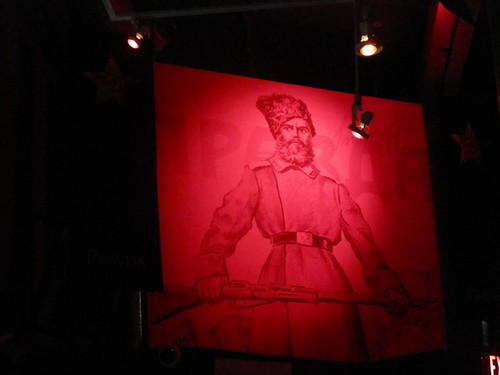
Now on to the juicy part, the Pravda Gala. Before walking in to the bar I realized that there was some sort of connection with the name and the vodka with the theme of the conference, but oh boy was in for a big surprise. This bar was completely themed after Soviet Russia. Now I did show images of the conference theme, but this took it to another level. This conference showed me the Ruby community in a different light. This bunch of people have a unique sense of humor, something that seems to be a requirement to get by in this field of work. This party allowed the alter egos of everyone at the conference to be free. You needed to be there for the conversations to understand this more but the images should suffice.


I screwed myself when I booked my return flight before the schedule for the conference was out. I booked my flight for 2:30pm on Sunday. Which meant that I missed a good part of the Sunday lineup which was:
Speaker: Collin Miller
Description: Much of what code editors do cover up for the gross impedance mismatch between machines and code. The artifacts of code misshape language design, system architecture, “the community”, and the craft as a whole. Cast off the robes of the textual high-priesthood and think about constructing programs instead of encoding them.
Notes: Did you even think that text was next the best mean of representation? Collin thinks so, and hes not talking about using images to describe something visual, hes talking about programming and writing code in something other than text! Interesting talk.
Speaker: Dr. Nic Williams
Description: I will be a developer for another 37 years; and by that time I might have created or maintained 500 to 1000 open source projects. In the last 3 years it is already a become maintenance challenge and in another 37 years I may be begging to retire. That is, unless we can solve the problem today: how to go from 1 to 1000 open source projects and still enjoy yourself. This talk will challenge much of the dogma of open source and will make you rethink what is open source? And how the hell do you live with it once its written?
Notes: awesome presentation! I wish I could get to a point where I can do what Dr. Nic was preaching, which simply was: develop a project that you want to use to solve a problem you want to solve, then ditch it. If youre the creator of a project it doesnt mean youve inherited it for life and it doesnt mean that the project cant survive without you. You CAN retire!
Speaker: Matthew Knox
Description: The Milgram experiments revealed a number of exploitable weaknesses in human psychology, and demonstrated that our collective human intuition drastically overestimates the difficulty of getting ordinary people to do extraordinarily awful things. Im going to talk about those weaknesses, their exploitation, consequences, and aftermath.
Notes: Good talk about owning what you do and being responsible for the code we unleash on the world. I had to leave before the end of this talk, sorry Mat!
Speaker: Paul Dowman
Description: If you dont engineer a battleship will you be swallowed by the Failwhale? Wheres the middle ground? A discussion on the philosophy and practice of staying light and nimble without falling down under load.
Speaker: Joseph Wilk
Description: Saucy Multilingual Cucumber seeks Fun and Frolics. Good-looking plaintext acceptance testing framework seeks meaningful relationship with devs, testers and non-techies too. Cucumber to my friends, Cuke to my lovers, I yearn to help you strive towards your business value. Very open minded, I enjoy a good web framework but am willing to get funky with whatever tickles your fancy (iPhone, Erlang, GTK and even Java). Most of all, Id love to watch you, erm, refactor, and I can keep you safe while you achieve your business and coding dreams. Must speak one of my 23 languages or help me learn a new one. P.S: Dont be shy, Joseph Wilk knows me as intimately as anyone – hes been like a father to me – hell show you how to treat me right. Dont worry though – Im easy to pick up and I dont bite (unless you want me to).
Speaker: Avi Bryant
Description: No description available. FAIL.
Speaker: Jonathan Dahl
Description: Art, music or words, and software too find limits freeing. Is less more?
Speaker: Francisco Tomalsky
Description: Francisco is a co-founder of 280 North and the creator of the Objective-J programming language. 280 North is bringing desktop-class applications to the browser with their new open source framework, Cappuccino. They recently launched 280 Slides, the first application built on Cappuccino. Before 280 North, Francisco was an early member of the iPhone team at Apple, working on Mobile Safari and Maps.
Speaker: Jesse Hirsh
Description: It is important that we understand the history of Imperial California and the means by which its ideology infects us all. From Hearst and De Young to Kevin Kelly and Chris Anderson the Californian Ideology is the hegemony that prevents other great cities or ideas from rising. Intrinsically we fight these ideas with our own, yet doing so blindly prevents us from seeing who struggles with us, and with whom we stand in solidarity. This presentation will help Future Ruby understand its role in ending Californias reign.
All in all it was great conference. Those who werent there missed out. I hope there will be a future FutureRuby conference (no pun intended)!
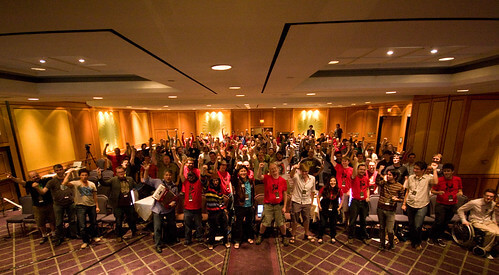
Credit is where credits due: Thank you @peteforde and @meghatron and @juliehache and @hyfen and all the other organizers/volunteers for a great conference. Thanks for all the speakers and presenters. Thanks for all the rubyists and non-rubyists who attended. And thanks to everyone on Flickr who provided great pics, including: aquateamhungryfort, luismi_cavalle, soukias, Edward OG, rtlechow, Austin Ziegler and Leftist (in no particular order). For more images check out: Flick